
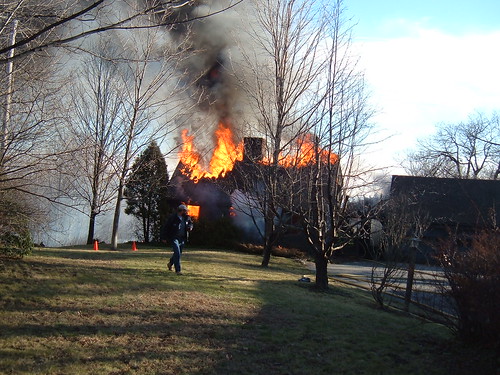
 December 21, 2006 at 1341 the dispatch center took a call for a building fire across from 23 Ledge Road.
Hancock was dispatched as a first alarm and additional mutual aid units from Peterboro, Stoddard and Nelson were also started.
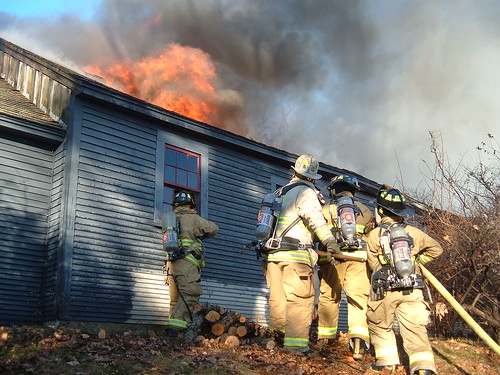
At 1346 14C3 requests a 2nd alarm and fire units from Bennington, Stoddard, Dublin, Harrisville, Greenfield, Antrim and MAC1 were sent to the fire scene. Jaffrey, Antrim, Francestown, Temple, New Ipswich, Marlow, and Hillsboro covered stations that had equipment at the fire. The American Red Cross was dispatched to scene for refreshments and care of the property owner. The fire was reported as under control at 1529.
All photos by George Brown.

Fire Extinguishers
Approximately every 16 seconds a fire department responds to a fire somewhere in the United States. The annual property loss from fire is in excess of BILLION. Roughly every two hours, someone will die in a fire. The proper use of a fire extinguisher may have prevented these mishaps. A fire extinguisher is probably the most common fire protection device available to the employees of your property. Most portable fire extinguishers are designed so that someone with just a little training can extinguish a fire that has just begun to burn. However, if your employee is completely unfamiliar with the proper use or basic understanding of the type of extinguisher, they can make a bad situation worse. Using the wrong type of extinguisher could increase the fire dramatically, endangering other employees and increasing the dollar loss. Employers who provide fire extinguishers should also provide the training necessary to use the extinguisher properly. Proper training is just as important as providing fire extinguishers, if not more so.
Where is the closest fire extinguisher in your area? Do you know how to use it? Look at the symbols on the extinguisher;
An 'A' in a triangle is an extinguisher that will fight ordinary combustibles, such as burning trash or cloth.
A 'B' in a square is an extinguisher that will fight flammable liquid fires, such as grease or oils or gasoline.
A 'C' in a circle is an extinguisher that will fight energized electrical fires, such as burning wires or switches.
A 'D' in a star is an extinguisher that will fight combustible metal fires, such as titanium or magnesium.
Some extinguishers are multipurpose and can fight more than one class of fire. You may see an extinguisher near your work area that has an 'A-B-C' rating on it. This type can fight ordinary combustibles, flammable liquids and electrical fires, but would be of no use on a metal fire.
Kitchens need a fire extinguisher rated at 40-B:C near the grease cook line in addition to a 2-A:10-B:C extinguisher located throughout the kitchen area. All extinguishers shall be conspicuously located where they will be readily accessible and immediately available in the event of a fire. Preferably they will be located along normal paths of travel and within 75' travel distance to any point in the building, as a general rule.
Remembering the word PASS can help you remember how to use the fire extinguisher;
Pull - the safety pin at the top of the extinguisher.
Aim - the nozzle or hose at the base of the fire, standing about 6' - 8' away.
Squeeze - or depress the handle.
Sweep - gently from side to side until the fire is out.
Warn others of the fire, so they may get out of the building, and what is most important, call the fire department before attempting to extinguish a small fire. Should you make the decision to fight the fire, always keep the exit to your back and never let the fire get between you and your way out.
Remember, the extinguisher will only last a few seconds, use it wisely.
Fire extinguishers have to be maintained in order to work properly. They must be serviced on an annual basis or if the gauge on the top of the extinguisher shows a low reading. The tag on the extinguisher shows the last time it was serviced. Of course, if the tag is missing, the extinguisher again needs to be serviced.
Selection of extinguishers depends on the hazards expected. For assistance in purchasing or locating your extinguishers, contact a state certified individual or firm. The Yellow Pages is a great place to start. Many of these companies offer classes on the use of their extinguishers.
Smoke Alarms/Detectors
 Smoke alarms save lives.
A fire department responds to a fire somewhere in the United States every 16 seconds. A residential fire occurs every 74 seconds. The majority of fires that kill people happen at night. If you?re asleep, the smell of smoke won?t always wake you up. In fact, smoke and poisonous gases can put you into a deeper sleep. Inexpensive smoke alarms can wake you in time to escape, greatly increasing your chances of survival.
How to choose an alarm.
Be sure that the smoke alarm carries the label of an independent testing lab (i.e. UL). Some home alarms run on batteries, others on household current. There are also different sensor technologies, some faster to react when fires are smoldering, others faster when fires are openly flaming, ALL are fast enough to provide sufficient warning. All laboratory tested smoke alarms, regardless of type, will protect you if they?re installed and maintained properly.
How many do you need?
Install at least one smoke alarm on every floor of your home, including the basement and outside each sleeping area. Smoke alarms should also be installed in sleeping rooms, especially if you sleep with the doors closed. New home construction now require hard wired smoke detectors in each sleeping room in addition to each level of the home. If someone in the home is hearing impaired, install alarms that flash a strobe light as well as the audible alarm.
Where and how to install.
Smoke rises, so mount alarms high on a wall or on the ceiling.
To wall mount, position the alarm 5 to 12 inches from the ceiling. To ceiling mount, position the detector from the center of the space to, but not closer than, 5 to 12 inches from the nearest wall. In stairways without doors at the top or bottom, place the detector anywhere along the path smoke would take, observing the previously stated two rules. In stairways, such as those from a basement that have a closed door at the top of the stairs, mount the smoke alarm at the bottom of the stairway. Dead air trapped near the door at the top of the stairway could prevent the smoke from reaching the alarm. DO NOT install smoke alarms near a window, door or forced-air register where drafts could interfere with its operation. False Alarms
Cooking vapors, steam and other fumes sometimes "set- off" the smoke alarm. If this happens regularly, do not solve the problem by removing the battery. Instead, try relocating the smoke alarm further from the source of the smoke. Clean the smoke detector regularly using a vacuum cleaner without removing the cover following the manufacturer recommendations. Maintenance
Change the battery in battery operated detectors at least annually. Many smoke alarm models chirp periodically when battery replacement is required. Test the smoke alarm at least monthly. Replace the smoke alarm as recommended by the manufacturer or every 10 years. After 10 years of service, the sensor in the smoke alarm becomes unreliable.
What to do if your clothes catch fire
When one talks about fire, he/she should make sure that everyone knows what to do if his/her clothing starts to burn. A clothing fire can spread rapidly and must be handled correctly. Teach family members that if clothing catches on fire they must: 1. STOP! Do not run! (Running only makes the fire bigger)
2. DROP! (Drop to the ground or floor)
3. ROLL! (Roll over and over until the flames are smothered. Cover face with hands)
To avoid clothing fires, wear clothes that:
1. Fit close to the body, especially when near open flames
2. Are made of tightly woven fabrics.
NEVER use hands for putting out a fire. Hands are very delicate, easily injured and difficult to heal. Hands should only be used to protect the face. The face is even more sensitive because of the eyes, nose, and mouth.
Sample Fire Department Funeral Guidelines
Sample Fire Department Funeral Guidelines are for review only, not necessarily recommended by SWNHDFMA. PURPOSE
The purpose of this guide is to help establish procedures that will ensure proper support and care for a firefighter's family after the death of an active member of the fire department. These guidelines will also help ensure that proper honors are rendered.
OBJECTIVES
To standardize burial protocol
To promote the honor and respect for the fallen firefighter
To establish lines of authority and responsibilities during notification, funeral and burial proceedings
To establish criteria for each type of funeral: Class I, Class II, Class III, Class IV
To establish criteria as to whom these honors are rendered
CLASSIFICATIONS
Class I- A Class I death is to be considered for members of the department who are killed at the scene of an emergency incident or killed in responding to or returning from the scene of said incident. A Class I death will also include those that are injured at the scene and who later die as a result of these injuries. Class I will NOT include individuals who die of heart, lung, or other causes while not engaging in emergency activities at the time of death.
Class II- A Class II death pertains to members of the department who dies while on duty, but not due to injuries sustained while performing emergency activities.
Class III- A Class III death is a death occurring when an active employee is off duty and not relating to any emergency activities.
Class IV- A Class IV death pertains to the death of a retiree of the fire department.
NOTIFICATION
Line of Duty Death (Class I & II)-
The Chief Dispatcher on duty at the time of the incident will be responsible for contacting the Fire Chief and the Chaplain.
The Fire Chief and the Chaplain will be responsible for contacting the families of firefighters that have been killed in the line of duty. If the firefighter's next of kin are outside of the local township or county, it is the Chief's responsibility to notify the fire or police department nearest the family, and to arrange that a uniformed officer, preferably from the fire department, and accompanying local chaplain, to contact the family in person.
The Chaplain will be responsible for notifying the Public Information Officer and the Funeral Coordinator. Additionally, the Chaplain will contact any fraternal or employee organizations.
The Public Information Officer (PIO) will be responsible for contacting the Mayor's office, City Counsel, and any other appropriate dignitaries. The PIO will also notify all other stations within the department.
The Funeral Coordinator will notify the Honor Guard/Memorial Team.
Active Members/Off Duty Death (Class III)-
Department members that have knowledge of a fellow firefighter's death are encouraged to notify the department through the Chief Dispatcher.
The Dispatcher will then notify the department Chaplain and Administration after receiving and verifying prevalent information on the member's death and applicable funeral information.
The Chaplain, once notified, is then responsible for contacting the family and offering department assistance.
The Chaplain would then contact the department Funeral Coordinator and appropriate fraternal and employee organizations as per the family's wishes.
The department Administration will announce the death and any funeral/memorial arrangements to all stations.
The Funeral Coordinator will contact the Honor Guard Coordinator as per the family's wishes
Retiree Deaths (Class IV)-
The family of the deceased retiree is responsible for contacting the department if they wish department participation in the funeral service.
The Chaplain is responsible for contacting the family upon knowing the family's wishes for the department's participation.
The Chaplain then will contact the Funeral Coordinator and the Honor Guard Coordinator.
Official Announcement
The official announcement to the department should be made by the Chief or by a designated Communications officer assigned by the Chief.
The announcement should follow a set format, and be from the perspective of the Chief or ranking officer, regardless of who reads it.
The verbal announcement should be followed with typed copies to be distributed for posting in each station, with a follow up announcement once funeral plans are finalized.
After this announcement is made within the department, it may be made available as a formal written statement to the appropriate media outlets.
Sample Announcement
I, Chief __________, am sorry to report the death of ____ (number) of our brave firefighters. _____________ (name or names) died at _________ (time) (date may be necessitated, especially if death was not immediate) while __________ (actively working on, responding to, returning from) incident number _______ at _________ (location). Funeral arrangements are pending at this time, however, a formal announcement of the arrangements, and the department's participation will be made, within the wishes of the family (or families).
ADDITIONAL RESPONSIBILITIES
Funeral arrangements are the ultimate responsibility of the family, but the fire department will provide assistance if requested.
The Funeral Coordinator is responsible for coordinating all necessary department personnel before and during the funeral services. Additionally, the Funeral Coordinator will notify the Honor Guard Coordinator, Shift Coordinator, and any other appropriate agencies to be involved in the services. The Funeral Coordinator insures that the funeral/memorial runs smoothly.
GUIDELINES FOR SERVICES TO BE PROVIDED TO FAMILY BY THE DEPARTMENT
Class I- Line of Duty Death-
Prior to Services
Transportation to funeral home/cemetery to make arrangements
Services of Department Clergy/Chaplain offered to family
Services of Department Funeral Coordinator offered to assist family in making arrangements
Arrangement of Police Escorts for processional to cemetery
Chapel/Church Service
Fire Apparatus for processional to graveside (as well as standing fast at the funeral home during all viewing and visitation)
Color Guard at service
Pipers and Drum Corps at service
Graveside Service
Arched Aerial Ladders with Hanging Flag at entrance to cemetery
Fire Apparatus at gravesite
Color Guard
Services of Department Chaplain, if family wishes
Department Honors/Ceremony
Flag folding and presentation
Pipers and Drum Corps
Bugler to play 'Taps' at cemetery
Fire Walk of Honor
Class II- On Duty Death Not Pertaining To An Emergency Scene-
Prior to Services
Transportation to funeral home/cemetery to make arrangements
Services of Department Clergy/Chaplain available to family upon request
Services of Department Funeral Coordinator available upon request to assist family in making arrangement
Arrangement of Pall Bearers in appropriate uniforms
Arrangement of Police Escorts for processional to cemetery
Honor Guard at Casket
Fire Apparatus for processional to graveside
Color Guard at service, upon request
Pipers and Drum Corps at service, upon request
Graveside Service
Fire Apparatus at gravesite
Color Guard, upon request
Services of Department Chaplain available
Flag folding and presentation
Pipers and Drum Corps, upon request
Class III- Off Duty Death-
1. Prior to Services
Services of Department Clergy/Chaplain available to family upon request
Services of Department Funeral Coordinator available upon request to assist family in making arrangements
Arrangement of Pall Bearers in appropriate uniforms, upon request
Arrangement of Police Escorts for processional to cemetery, upon request
Chapel/Church Service
Honor Guard at Casket
Uniformed Personnel at service
Uniformed Personnel to serve as Pall Bearers, upon request
Pipers and Drum Corps at service, upon request
Graveside Service
Services of Department Chaplain available
Pipers and Drum Corps, upon request
Class IV- Retiree Death
1. Prior to Services
Services of Department Clergy/Chaplain available to family upon request
Arrangement of Pall Bearers in appropriate uniforms, upon request
Arrangement of Police Escorts for processional to cemetery, upon request
Chapel/Church Service
Honor Guard at Casket
Color Guard, upon request
Uniformed Personnel at service
Uniformed Personnel to serve as Pall Bearers, upon request
Pipers and Drum Corps at service, upon request
Graveside Service
Services of Department Chaplain available
Flag folding and presentation
Pipers and Drum Corps, upon request
GUIDELINES FOR THE FUNERAL/MEMORIAL SERVIC
Class I- Line of Duty Death
All available department personnel to attend in full class 'A' dress uniform, including off duty members.
All members will wear a black band over their badges from the time the death is announced until 24 hours after finish of service, and up to one week after death.
All department flags will fly at half-staff from the time the death is announced until at least 24 hours after finish of service, and up to one week after death.
All regular uniformed personnel will remain covered while outdoors, except during prayers, and uncovered indoors.
All Honor Guard members will be covered at all times during the performance of their duties.
Seating will be reserved as such that the family is nearest the casket followed by the Pall Bearers, the department officers, descending in rank, followed by all other members of the home department. Following that will be all visiting uniformed firefighters, from the longest distance traveled to the least traveled. The City Mayor, Councilmen, and other dignitaries (from Local to most Broad (i.e. Federal)), will be seated either to the side of all firefighters, or directly behind the home department.
Upon conclusion of the service, all personnel, starting with the Pall Bearers, and going further from the casket, will file out, being the first to leave, to assemble outside in preparation of the passing of the casket.
The casket will precede the family filing through the assembled firefighters to the Fire Apparatus or Funeral Coach of choice.
Directly behind the casket as it exits the chapel/church will be the immediate family, followed by extended family and all other attendees.
The Pall Bearers will then place the casket on the appropriate apparatus, or in the funeral coach, if chosen
Class II- On Duty Death-
1. All available department personnel encouraged to attend in full class 'A' dress uniform, including off duty members.
2. All members will wear a black band over their badges from the time the death is announced until 24 hours after finish of service.
3. All department flags will fly at half-staff from the time the death is announced until at least 24 hours after finish of service.
4. All regular uniformed personnel will remain covered while outdoors, except during prayers, and uncovered indoors.
5. All Honor Guard members will be covered at all times during the performance of their duties.
6. Seating will be reserved as such that the family is nearest the casket followed by the Pall Bearers, the department officers, descending in rank, followed by all other members of the home department. Following that will be all visiting uniformed firefighters, from the longest distance traveled to the least traveled. The City Mayor, Councilmen, and other dignitaries (from Local to most Broad (i.e. Federal)), will be seated either to the side of all firefighters, or directly behind the home department.
7. Upon conclusion of the service, all personnel, starting with the Pall Bearers, and going further from the casket, will file out, being the first to leave, to assemble outside in preparation of the passing of the casket.
8. The casket will precede the family filing through the assembled firefighters to the Fire Apparatus or Funeral Coach of choice.
9. Directly behind the casket as it exits the chapel/church will be the immediate family, followed by extended family and all other attendees.
10. The Pall Bearers will then place the casket in the funeral coach, if chosen
Class III- Off Duty Death
1. All available department personnel asked to attend in uniform,including off duty members.
2. All members will wear a black band over their badges from the time the death is announced until 24 hours after finish of service, and up to one week after death.
3. All department flags will fly at half-staff from the time the death is announced until at least 24 hours after finish of service, and up to one week after death.
4. All regular uniformed personnel will remain covered while outdoors, except during prayers, and uncovered indoors.
5. Seating will be reserved as such that the family is nearest the casket followed by the Pall Bearers, any department officers who wish to attend, followed by all other members of the department. Following that will be any visiting uniformed firefighters. Any dignitaries will be seated either to the side of all firefighters, or directly behind them.
6. Upon conclusion of the service, all personnel, starting with the Pall Bearers, and going further from the casket, will file out, being the first to leave, to assemble outside in preparation of the passing of the casket.
7. The casket will precede the family filing through the assembled firefighters to the Funeral Coach.
8. Directly behind the casket as it exits the chapel/church will be the immediate family, followed by extended family and all other attendees.
9. The Pall Bearers will then place the casket in the funeral coach.
Class IV- Retiree Death
All available department personnel to attend in full class 'A' dress uniform, including off duty members.
All members may wear a black band over their badges from the time the death is announced until 24 hours after finish of service.
All uniformed personnel at the service will remain covered while outdoors, except during prayers, and uncovered indoors.
All Honor Guard members will be covered at all times during the performance of their duties.
Seating will be reserved as such that the family is nearest the casket followed by the Pall Bearers, department officers, all other members of the home department, all visiting uniformed firefighters, and any applicable dignitaries
Upon conclusion of the service, all personnel, starting with the Pall Bearers, and going further from the casket, will file out, being the first to leave, assembling outside in preparation of the passing of the casket.
The casket will precede the family filing through the assembled firefighters to the Funeral Coach.
Directly behind the casket as it exits the chapel/church will be the immediate family, followed by extended family and all other attendees.
The Pall Bearers will then place the casket in the funeral coach.
GUIDELINES FOR PROCESSIONAL TO, AND ASSEMBLY AT GRAVESIDE
Class I- Line of Duty Death-
Note: There are two options for processing to the graveside, marching and vehicular procession.
Marching Processional- It is the responsibility of the Honor Guard Commander/Coordinator to ensure that the order for the marching processional is as follows, and that the Bugler is standing by at the cemetery
Piper (s) and Drummer (s)
Color Guard
Clergy/Department Chaplain
Apparatus/Funeral Coach with Pall Bearers and Honor Guard Escort
Immediate Family
Fire Chief, Department Officers in descending order of rank, and Dignitaries from most local to most broad
Home department uniformed personnel
Visiting Department uniformed personnel from the longest distance traveled to the least traveled
Home Department Additional Apparatus
Visiting Department Apparatus from the longest distance traveled to the least traveled
All other miscellaneous vehicles
Vehicular Procession Only- It is again the responsibility of the Honor Guard Commander/Coordinator to ensure that the order for the vehicular processional is appropriate, as follows, and that Piper (s), Drummer (s), Bugler and Color Guard are standing by at the cemetery.
Lead Car provided by funeral home, containing appropriate Clergy/Department Chaplain
Apparatus/Funeral Coach, with Pall Bearers riding inside if apparatus, or immediately following family in one vehicle if funeral coach
Car or Limousine with Immediate Family
Fire Chief Car followed by officer cars and dignitary cars
Additional Home Department Apparatus
Visiting Department Apparatus from the longest distance traveled to the least traveled
All other Home Department Personnel, if in personal vehicles
All other Visiting Department Personnel, if in personal vehicles
All other Miscellaneous Vehicles
Assembly at Graveside
Two crossed Aerial Ladders with a draped flag shall be at the entrance to the cemetery, so that the entire processional goes underneath them in entering
The Piper (s), Drummer (s) will be assembled approximately 100 yards from the gravesite, and the Bugler will assemble approximately 20 feet past the gravesite
Fire Walk of Honor- the members of the home department shall line up on both sides of the path, in an organized fashion from the Coach/Apparatus to the graveside, approximately 10 feet apart with all additional home department firefighters, and visiting department firefighters lining up behind the front row of firefighters
Once the firefighters are appropriately assembled, the Color Guard will line up at the beginning of the Walk of Honor followed by the Clergy/Chaplain
At this point the Pall Bearers will remove the casket from the Coach/Apparatus and the Honor Guard will command 'Firefighters, Attention' All firefighters will then come to attention, awaiting the command 'Firefighters, Present Arms' which will signal the Pall Bearers to begin carrying the casket down the Walk of Honor, and all firefighters will render a hand salute just as the casket nears them.
The casket will be followed in order by the Immediate Family, the Fire Chief and Officers, in descending rank, command staff, and other dignitaries
Once the casket reaches the gravesite, the piper (s) and drummer (s) will begin playing 'Amazing Grace' as they approach from the distance, marching to approximately 20 feet from the foot end of the graveside
After the piper (s) and drummer (s) reach their appropriate places, the command 'Firefighters, Order Arms, Fall In' will be given, instructing the firefighters to move from their places in the Walk of Honor, to orderly lined directly behind the family, who are to be seated directly in front of the casket
The appropriate Clergy/Chaplain then should step forward with the graveside message, which should include the 23rd Psalm, and Firefighter's prayer, depending upon the wishes of the family.
At the close of the graveside message, the Clergy/Chaplain will then commence with 'Let us now pray.' At this time, all are expected to remove and order their covers to their sides, and bow their heads in respect.
Once the Clergy/Chaplain has finished his prayer, all personnel will recover, and the Honor Guard will remove the flag from the casket, and fold it for presentation to the family.
The flag will be passed from one member of the honor guard to the honor guard commander, with both members of the honor guard saluting as it passes.
The presentation to the next of kin will be made by the honor guard commander, who will present it as he explains, 'This flag is presented on behalf of a grateful ________ (city, township, county, etc.), as a small token of our appreciation for the honorable and faithful service, and great sacrifice of your loved one.
It is then appropriate for the dispatcher to read this farewell message over the radio. 'The members of the _________ Fire Department wish to thank ______________ (rank and name) for his/her ___ (#) years of services to the citizens of this (city, city, township, county, etc) of ________ (name). Although you are gone, you will never be forgotten.'
At the conclusion of this, the Honor Guard Commander will command 'Firefighters, Attention, Present Arms' and the bugler will begin to play 'Taps'
At the conclusion of 'Taps' the command 'Firefighters, Order Arms' will be rendered, and the firefighters will stand at attention until the family has begun to depart.
At this point the honor guard commander will command, 'Firefighters, Dismissed' concluding the services
Class II- On Duty Death
Procession- It is again the responsibility of the Honor Guard Commander/Coordinator to ensure that the order for the vehicular processional is appropriate, as follows, and that Piper (s) and Drummer (s) are standing by at the cemetery.
Lead Car provided by funeral home, containing appropriate Clergy/Department Chaplain
Funeral Coach, with Pall Bearers immediately following family in one vehicle
Car or Limousine with Immediate Family
Fire Chief Car
Additional Home Department Vehicles
Visiting Department Vehicles
All other Home Department Personnel
All other Visiting Department Personnel
All other Miscellaneous Vehicles
Assembly at Graveside
The Piper (s) and Drummer (s) will be assembled approximately 100 yards from the graveside
At this point the Pall Bearers will remove the casket from the Coach and begin carrying the casket to the graveside
The casket will be followed in order by the Immediate Family, the Fire Chief and firefighters
Once the casket reaches the gravesite, the piper (s) and drummer (s) will begin playing 'Amazing Grace' as they approach from the distance, marching to approximately 20 feet from the foot end of the graveside
The appropriate Clergy/Chaplain then should step forward with the graveside message, which should include the 23rd Psalm, and Firefighter's prayer, depending upon the wishes of the family.
At the close of the graveside message, the Clergy/Chaplain will then commence with 'Let us now pray.' At this time, all are expected to remove and order their covers to their sides, and bow their heads in respect.
Once the Clergy/Chaplain has finished his prayer, all personnel will recover, and the Honor Guard will remove the flag, if applicable, from the casket, and fold it for presentation to the family.
The flag will be passed from one member of the honor guard to the honor guard commander, with both members of the honor guard saluting as it passes.
The presentation to the next of kin will be made by the honor guard commander, who will present it as he explains, 'This flag is presented on behalf of a grateful ________ (city, township, county, etc.), as a small token of our appreciation for the honorable and faithful service of your loved one.
It is then appropriate for the dispatcher to read this farewell message over the radio. 'The members of the _________ Fire Department wish to thank ______________ (rank and name) for his/her ___ (#) years of services to the citizens of this (city, city, township, county, etc) of ________ (name). Although you are gone, you will never be forgotten.'
At this point the services are concluded
Class III- Off Duty Death
Procession- It is again the responsibility of the Honor Guard Commander/Coordinator to ensure that the order for the vehicular processional is appropriate, as follows, and that Piper (s) and Drummer (s) are standing by at the cemetery.
Lead Car provided by funeral home, containing appropriate Clergy/Department Chaplain
Funeral Coach, with Pall Bearers immediately following family in one vehicle
Car or Limousine with Immediate Family
Fire Chief Car
Additional Home Department Vehicles
All other Department Personnel
All other Vehicles
Assembly at Graveside
The Piper (s) and Drummer (s) will be assembled approximately 100 yards from the graveside
At this point the Pall Bearers will remove the casket from the Coach and begin carrying the casket to the graveside
The casket will be followed in order by the Immediate Family and present firefighters
Once the casket reaches the gravesite, the piper (s) and drummer (s) will begin playing 'Amazing Grace' as they approach from the distance, marching to approximately 20 feet from the foot end of the graveside
The appropriate Clergy/Chaplain then should step forward with the graveside message, which should include the 23rd Psalm, and Firefighter's prayer, depending upon the wishes of the family
At the close of the graveside message, the Clergy/Chaplain will then commence with 'Let us now pray.' At this time, all are expected to remove and order their covers to their sides, and bow their heads in respect.
Once the Clergy/Chaplain has finished his prayer, all personnel will recover.
It is then appropriate for the dispatcher to read this farewell message over the radio. 'The members of the _________ Fire Department wish to thank ______________ (rank and name) for his/her ___ (#) years of services to the citizens of this (city, city, township, county, etc) of ________ (name). Although you are gone, you will never be forgotten.'
At this point the services are concluded
Class IV- Retiree Death
Procession- It is the responsibility of the Funeral Coordinator to ensure that the order for the vehicular processional is appropriate, as follows, and that Piper (s) and Drummer (s) are standing by at the cemetery, according to the families wishes.
Lead Car provided by funeral home, containing appropriate Clergy
Funeral Coach, with Pall Bearers immediately following family
Car or Limousine with Immediate Family
Fire Chief Car
Additional Department Vehicles
All other Department Personnel
All other Vehicles
Assembly at Graveside
The Piper (s) and Drummer (s) will be assembled approximately 100 yards from the graveside, according to the wishes of the family
At this point the Pall Bearers will remove the casket from the Coach and begin carrying the casket to the graveside
The casket will be followed in order by the Immediate Family and present firefighters
Once the casket reaches the gravesite, the piper (s) and drummer (s) will begin playing 'Amazing Grace' as they approach from the distance, marching to approximately 20 feet from the foot end of the graveside.
The Clergy then should step forward with the graveside message, which should include the 23rd Psalm, and Firefighter's prayer, depending upon the wishes of the family.
At the close of the graveside message, the Clergy will then commence with 'Let us now pray. At this time, all are expected to remove and order their covers to their sides, and bow their heads in respect.
Once the Clergy has finished his prayer, all personnel will recover.
If it is then appropriate, according to local customs, for the dispatcher to read this farewell message over the radio. 'The members of the _________ Fire Department wish to thank ______________ (rank and name) for his/her ___ (#) years of services to the citizens of this (city, city, township, county, etc) of ________ (name). Although you are gone, you will never be forgotten.'
At this point the services are concluded.
Photo
Placeholder for statistics on a dynamically generated set of pages
Quisque iaculis facilisis lacinia. Mauris euismod pellentesque tellus sit amet mollis.